Showing posts with label Tidbit_Tuesdays. Show all posts

Tuesday, April 28, 2020

Tuesday Tidbit: Metropolitan Museum of Art


While growing up in New Jersey, I often visited historic landmarks, museums, galleries, and other sites of interest in New York City during school field trips. One of the places most often visited by my school groups was the Metropolitan Museum of Art, a gorgeous quarter-mile long building of nearly two million square feet.

Celebrating its centennial this year, the Met (as it’s known) contains collections of Egyptian, Babylonian, Assyrian, East Asian, Middle Eastern, Greek, Roman, European, pre-Columbian, New Guinean, Islamic, and American art including sculpture, paintings, drawings, calligraphy, prints, photographs, glass, bronzes, ceramics, textiles, metalwork, lacquerwork, furniture, period rooms, arms and armor, and musical instruments. (Whew!)

Founded by businessmen, financiers, and artists, The Met received its articles of incorporation on April 13, 1870, with the museum opening on February 20, 1872 in the Dodworth Building on Fifth Avenue. Railroad executive John Taylor Johnston was the first president, perhaps prompted by the fact that his personal art collection seeded the museum. Eight years later, the museum had outgrown its location twice and moved to the current location. By the early 20th Century, The Met was considered one of the greatest art centers in the world.

Every organization needs a mascot, and The Met proudly hosts “William” a 4,000+ year old statute of a hippopotamus as theirs. The piece was gifted to the museum in 1917 by Edward S. Harkness, an American philanthropist, whose father Stephen V. Harkness made his wealthy by an early investment in Standard Oil. Discovered during the Khashaba excavations in Egypt in 1910, the statue is nearly eight inches long, three inches wide, and four and one-half inches tall.

The fourth most visited museum in the world, The Met hosted 7.3 million visitors in 2019. In addition to its main facility on Fifth Avenue, The Cloisters is located in Fort Tryon Park and built using salvaged structures from five medieval French cloisters. Dedicated only to medieval art, the facility was completed in 1938 and filled with a collection originally assembled by George Gray Barnard and purchased in full by John D. Rockefeller, Jr. in 1925 as a gift to the Met.

A popular location with movie directors, The Met has been featured in dozens of films including When Harry Met Sally, Hello Again, The Nanny Diaries, Hitch, and Keeping the Faith.

Have you ever visited The Met? What is your favorite art gallery?

_________________


Linda Shenton Matchett writes about ordinary people who did extraordinary things in days gone by. A volunteer docent and archivist for the Wright Museum of WWII, Linda is also a trustee for her local public library. She was born a stone’s throw from Fort McHenry and has lived in historic places all her life. Now located in central New Hampshire, Linda’s favorite activities include exploring historic sites and immersing herself in the imaginary worlds created by other authors. Visit her website where she blogs about history, mystery, and faith.

Tuesday, April 14, 2020

Tuesday Tidbit: Anna Sewell and Black Beauty


Everyone has a favorite childhood book (or two or three…), and for some reason mine seem to revolve around horses. Misty of Chincoteague, My Friend Flicka, and Black Beauty. I was a teenager before I had an opportunity to ride a horse, and the day ended when the animal ran under a tree and swept me off her back. But that’s a story for another day.

In researching this post, I was stunned to discover that the book was published in 1877, almost one hundred years prior to my falling in love with the story. Published shortly before her death, Black Beauty is the only book Anna Sewell wrote. With fifty million copies sold, Black Beauty is considered one of the top ten children’s books, and is the first English novel to be told from the perspective of an animal. Written over the course of six years, Anna became ill before completing the manuscript and dictated much of the text to her mother.

Born March 20, 1820, Anna Sewell was born into a devout Quaker family. Her mother was a successful children’s book author who homeschooled Anna and her brother Philip. Her father owned a small shop that failed, and as a result, the family moved quite a bit in his search for employment. Anna’s maternal grandparents often took care of her and Philip.

When she was a teenager, Anna fell and injured her ankles that never healed properly. She was unable to walk without a crutch or stand for long periods of time. Over the years, she traveled to health spas in Germany and Spain to get relief and healing. However, she was unsuccessful, remaining an invalid for the rest of her life.

As an effort to give herself mobility, she used a horse-drawn chaise to get around. The regular use of the horse combined with living in a society dependent upon horsepower gave Anna pause to think about the humane treatment of animals. She intended the book as an instruction piece for those who worked with horses and other service animals, not as a children’s book.

Anna received one payment of £40 from her publisher, and the book was released on November 24, 1877. She passed away five months later on April 25, 1878.


______________________


Linda Shenton Matchett writes about ordinary people who did extraordinary things in days gone by. A volunteer docent and archivist for the Wright Museum of WWII, Linda is also a trustee for her local public library. She is a native of Baltimore, Maryland and was born a stone’s throw from Fort McHenry. Linda has lived in historic places all her life, and is now located in central New Hampshire where her favorite activities include exploring historic sites and immersing herself in the imaginary worlds created by other authors. Learn more about Linda and her book on her website or connect with her online: http://www.LindaShentonMatchett.com


Tuesday, March 24, 2020

Tidbit Tuesday: Truth or Consequences


Are you a fan of game shows?

At one time, I was an avid follower of Wheel of Fortune. Pat Sajak’s snarky yet gracious personality mixed with the fun of trying to solve the puzzle before the contestants drew me in. Then life got busy, and I watched fewer and fewer episodes.

Today, television is home to dozens of game shows: The $100,000 Pyramid (which started out as The $10,000 Pyramid in 1973), 25 Words or Less, Are You Smarter Than a Fifth Grader, Beat Shazam, Brain Games, Cash Cab, and Family Feud, just to name a few.

Radio hosted game shows long before television, with one of the first being Ralph Edwards’s Truth or Consequences. In an interview, Edwards stated the idea came from a favorite parlor game called Forfeits. A Victorian era pastime, Forfeits had many iterations, but the commonality was the requirement for the loser to perform a stunt such as barking like a dog, making three people laugh, singing a song, dancing, walking in a circle backwards, or some other silly action.

First broadcast on March 23, 1940, Truth or Consequences was a huge success with listeners. On the show, contestants had two seconds to answer a trivia question before “Beulah the Buzzer” sounded. If the individual didn’t complete the “Truth” portion, there would be “Consequences,” usually an embarrassing stunt. Years later, Edwards would say that most of the contestants preferred to answer incorrectly in order to do the stunt.

On July 1, 1941, the show was the first game show to air on broadcast television. However, the airing was a one-time experiment, and the program didn’t air again on TV until 1950, when the medium had caught on commercially.

Other milestones for the show were the appearance of Superman in Action Comics #127 in December 1948, and the renaming of Hot Springs, New Mexico to Truth or Consequences when the town agree to host a radio episode in exchange for the name change.

A savvy producer, Edwards arranged to have Truth or Consequences to be recorded on 35mm film, using multiple cameras simultaneously-the first TV program recorded before a live audience to do so. In January, 1957, the show became the first program to be broadcast in all time zones from a prerecorded videotape.

Truth or Consequences went off the air in 1958, then attempted a failed revival during the 1977-78 season, and again during the 1987-88 season. In 2012, discussions were had about yet another revival, but the show never came to fruition.

Do you enjoy game shows? If so, what is your favorite?
_______________________


Linda Shenton Matchett writes about ordinary people who did extraordinary things in days gone by. A volunteer docent and archivist for the Wright Museum of WWII, Linda is also a trustee for her local public library. She is a native of Baltimore, Maryland and was born a stone’s throw from Fort McHenry. Linda has lived in historic places all her life, and is now located in central New Hampshire where her favorite activities include exploring historic sites and immersing herself in the imaginary worlds created by other authors. Learn more about Linda and her book on her website or connect with her online: http:www.LindaShentonMatchett.


Tuesday, March 17, 2020

It’s Women’s History Month By Shirley Raye Redmond


Shirley here. Godly women are light and salt in our world. As March is Women’s
History Month, I thought it might be fun to offer a multiple choice quiz
to test your WHQ—women’s history quotient. The answers are provided
at the end of the quiz. Good luck!

(1) Who was the first licensed female watchmaker in the
Netherlands?
(A) Greta Brinker
(B) Corrie Ten Boom
(C) Maria Van Dyke

(2) Who was the first pilot to ever fly for the Missionary Aviation
Fellowship—yes, the pilot was a woman!
(A) Amelia Earheart
(B) Elizabeth Greene
(C) Beryl Markham

(3) Who was the most prolific female hymn writer of all time? Hint:
She was blind from infancy.
(A) Katherine Anne Porter
(B) Fanny Crosby
(C) Katherine Lee Bates

(4) Who opened the first orphanage for African American children
in 1899 near Chicago:
(A) Jane Addams
(B) Amanda Smith
(C) Harriet Beecher Stowe

(5) Pastor Alexander Whitaker taught her to read the Bible and
speak English. When baptized she took the name Rebecca and
married an English widower named John Rolfe. Who was she?
(A) Tucumcari
(B) Pocahontas
(C) Kateri

(6) One of the fastest runners in the world, she won three Olympic
gold medals. Hard to believe she was crippled with polio when
she was a baby. Who was she?
(A) Babe Didrickson
(B)
(C) Wilma Rudolph
(D) Tamika Catchings Smith

(7) As a lighthouse keeper in Rhode Island, she saved more than a
dozen men from drowning during her amazing career. She
received many honors and awards, including a visit from
President Ulyssess Grant who came to thank her personally for
her dedication to the United States Lighthouse Service. Who
was she?
(A) Jane Austen
(B) Ida Lewis
(C) Louisa May Alcott

Answers: The correct answer for each question is letter B. You can
learn more about these amazing women and others like them in my latest
book, Courageous World Changers: 50 True Stories of Daring Women
of God.

Women of Fearless Faith

Meet women who have used their God-given talents to live out their faith to the fullest. They come from a variety of backgrounds, eras, and ethnicities, but each one has answered the Lord’s call on their life in bold and innovative ways.

Children of all ages will be inspired by the stories of
  • Corrie ten Boom—activist, author, and Holocaust survivor
  • Laurie Hernandez—gymnast who won both gold and silver medals in her sport
  • Florence Nightingale—health care reformer
  • Madeline L’Engle—author of children’s literature
  • Mother Teresa—missionary and winner of the Nobel Peace Prize
These and the 45 other female spiritual role models featured in this book have made a profound impact on the world around them, and in many cases changed the course of history. Strong, smart, and sometimes outspoken, these women are tremendous examples of God’s love in action.

These inspiring profiles will captivate kids’ imaginations and encourage them to discover their own gifts and how they can use them to glorify God.               


An award-winning writer and frequent conference speaker, Shirley Raye Redmond is the author of Courageous World Changers: 50 True Stories of Daring Women of God (Harvest House). She holds an M.A. in literature and has been married to her husband Bill for over forty years. They live in New Mexico where she is prayer chairman for her local Community Bible Study (CBS). Touch base at shirleyrayeredmond.com or Facebook.

Tuesday, March 10, 2020

Tidbit Tuesday: Happy Birthday Dr. Seuss!


Born in Springfield, Massachusetts on March 2, 1904, Theodor “Ted” Seuss Geisel took on the moniker “Dr. Seuss” while still an undergraduate at Dartmouth College. One story claims Geisel was caught drinking (illegal in 1924 during Prohibition) and forced to give up all his extracurricular activities which included editorship of Dartmouth’s humor magazine, the Jack-O-Lantern. In order to continue working on the publication, he signed his work “Seuss.” He continued to use the pseudonym as a graduate student at Lincoln College, Oxford.

Leaving Oxford before graduation her returned to the US where he obtain work as a cartoonist for several magazines such as Vanity Fair and Life. He also secured advertising work with his illustrations for FLIT and Standard Oil being his most well-known. The New York newspaper PM hired him as a political cartoonist.

Wildly successful, Geisel and his wife became wealthy and used their funds to travel extensively. During a trip home on a cruise in 1936, he was inspired to write his first children’s book, And To Think I Saw It On Mulberry Street (a real street a short distance from where he grew up). According to his own account he received dozens of rejections and considered burning the manuscript until a serendipitous meeting with one of his former Dartmouth classmates let to its publication with Vanguard Press. By 1940, he published three more children’s books.

With the advent of WWII, Geisel set aside children’s literature efforts. He stepped up his production of political cartoons for PM, drawing over 400 in two years. During that time, he also drew posters for the Treasury
Department and War Production Board. In 1943, he joined the US Army as a captain and was giving command of the Animation Department of the First Motion Picture Unit of the Army Air Force where he wrote propaganda and training films.

After the war, Geisel and his wife moved to California where he went back to writing children’s books, most of which sold hundreds of thousands of copies. He passed away from cancer in September, 1991.

What is your favorite Dr. Seuss book?

_________________________

Linda Shenton Matchett writes about ordinary people who did extraordinary things in days gone by. A volunteer docent and archivist for the Wright Museum of WWII, Linda is also a trustee for her local public library. She is a native of Baltimore, Maryland and was born a stone’s throw from Fort McHenry. Linda has lived in historic places all her life, and is now located in central New Hampshire where her favorite activities include exploring historic sites and immersing herself in the imaginary worlds created by other authors. Learn more about Linda and her book on her website or connect with her online: Facebook, Twitter, or Pinterest.


Tuesday, January 28, 2020

Tidbit Tuesday: The Three Stooges vs. Hitler


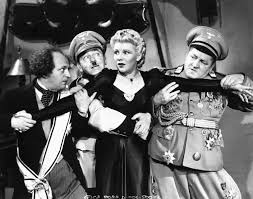
Ten months before Charlie Chaplin released The Great Dictator, the Three Stooges came out with You Nazty Spy. Produced by Columbia Pictures in January 1940, the film came out four months after Germany invaded Poland, and nearly a year before the U.S. entered the war.

Comprised of Larry Fine, and brothers Moe and Curly Howard, the Three Stooges began as the vaudeville act “Ted Healy and His Stooges” in 1922. Larry and Moe were the original stooges with the third played by various individuals throughout their fifty-year career. In 1934, the trio signed a contract with Columbia and became wildly popular within their first year. Their movies were typically “shorts,” films less than thirty minutes.

After WWII began, the Stooges (all of whom had Jewish heritage) put out several pieces that poked fun at Hitler and the Nazis, the first being You Nazty Spy with a sequel I’ll Never Heil Again the following year. Moe played “Moe Hailstone,” an Adolf Hitler-like character from Moronica, with Larry playing a Joachim von-Ribbentrop-type ambassador and Curly playing a Hermann Göring character. Consider by most to be the actors’ best film, You Natzy Spy is also the Stooges’ favorite.

In the movie, the evil cabinet ministers overthrow the king and decide to put Moe the new ruler, believing that he’ll be stupid enough to follow their orders. After successfully committing mayhem, the trio is run out of office by a mob and eaten by lions. A bit of a dark ending, but audiences loved it.

You Nazty Spy opens with a disclaimer that reads: “Any resemblance between the characters in this picture and any persons, living or dead, is a miracle.” Was this a Stooge-style eye poke at the censors or an attempt to appease them?

Other wartime movies by the Stooges included They Stooge to Conga, Higher Than a Kite, Back from the Front, Gents without Cents, and No Dough Boys. An anti-Japanese film The Yoke’s On Me was issued in 1944.  

Have you seen any of the Stooges’ wartime films?

___________________
___________________________
Linda Shenton Matchett writes about ordinary people who did extraordinary things in days gone by. Her latest release, Under Ground, features WWII war correspondent, Ruth Brown. A volunteer docent and archivist for the Wright Museum of WWII, Linda is also a trustee for her local public library. She was born a stone’s throw from Fort McHenry and has lived in historic places all her life. Now located in central New Hampshire, Linda’s favorite activities include exploring historic sites and immersing herself in the imaginary worlds created by other authors. Visit her website where she blogs about history, mystery, and faith. Sign up for her newsletter and receive a free short story. You can also connect with Linda on Facebook, Twitter, and Pinterest.


Tuesday, January 7, 2020

Courageous World Changers, book review


Courageous World Changers By Shirley Raye Redmond: Meet women who have used their God-given talents to live out their faith to the fullest. They come from a variety of backgrounds, eras, and ethnicities, but each one has answered the Lord’s call on their life in bold and innovative ways.

Children of all ages will be inspired by the stories of
·         Corrie ten Boom—activist, author, and Holocaust survivor
·         Laurie Hernandez—gymnast who won both gold and silver medals in her sport
·         Florence Nightingale—health care reformer
·         Madeline L’Engle—author of children’s literature
·         Mother Teresa—missionary and winner of the Nobel Peace Prize


These and the 45 other female spiritual role models featured in this book have made a profound impact on the world around them, and in many cases changed the course of history. Strong, smart, and sometimes outspoken, these women are tremendous examples of God’s love in action.

These inspiring profiles will captivate kids’ imaginations and encourage them to discover their own gifts and how they can use them to glorify God.

Heidi here. In a day where young girls are being told they can be anything, do anything, don't let their gender rule them, Courageous World Changers by Shirley Raye Redmond is a breath of fresh air. These are women who were courageous with God as their focus.

Though there are some women you will recognize in this book, some are obscure women I've only vaguely heard of. And who doesn't like to learn a little now and again?

I specifically liked the quote from Mahalia Jackson, "Faith and prayer are the vitamins of the soul; man cannot live in health without them." Gabby Douglas' story was inspiring, ending with "All the glory goes to God." Condoleezza Rice, influential political adviser, says "faith and reason are not enemies of one another, that indeed we are called to love the Lord our God with our hearts and our minds."

I received this book free from the publisher and the author. I was not required to write a positive review. The opinions I have expressed are my own.

Grab your copy of Courageous World Changers by Shirley Raye Redmond today!

Tuesday, December 10, 2019

Those Amazing Women and Their Flying Machines


Seventy-five years ago this month, the Women’s Air Service Pilots organization was disbanded. A federal organization, the WASPs was formed seventeen months earlier by merging the Women’s Flying Training Detachment and the Auxiliary Ferrying Squadron, both created in September 1942. 

As civilians, members of the WASPs were not in the military, however, in June 1944 the House considered HR 4219, a bill that would grant them military status. It was defeated 188 to 169. Two weeks prior, the House Committee on the Civil Service (Ramspeck Committee) reported that it deemed the WASPs “unnecessary” and “unjustifiably expensive,” having cost the government $50 million. They recommended the program be halted. 

During its period of operation, each member’s service had freed a male pilot for combat or other duties. The women flew over sixty million miles, transported every type of military aircraft, towed targets for live anti-aircraft gun practice, simulated strafing missions, and transported cargo.

More than 25,000 women applied to the WASPs. Qualifications were that the applicant must be between 21 and 35 years old, at least 5’2” tall, in good health, hold a pilot’s license, and have a minimum of 500 hours of flight time. Over 1,800 were accepted, the majority of whom were Caucasian. There were two Chinese-Americans, two Mexican-Americans, and one Native American.

Of those accepted, 1,074 completed the training. Although they were not trained for combat, their course of instruction was almost the same as male aviation cadets. The women received no gunnery training and very little formation and aerobatic flying, but they did go through the maneuvers necessary to be able to recover from any position. By graduation, WASPs had 560 hours of ground school and 210 hours of flight training. In addition, they knew Morse code, meteorology, military law, physics, aircraft mechanics, and navigation. 

On December 7, 1944 (Pearl Harbor Day), the last class of WASP pilots graduated from training, despite the plan to disband the organization. After the announcement was made, nearly two dozen women offered to continue the work at a salary of $1.00 per year, but the offer was rejected. Following the group’s disbandment, some WASP members were allowed to fly on board government aircraft as long as room was available and no additional expenses were incurred. The other had to arrange and pay for their own transportation home.

Several times during the 1970s efforts were made to gain recognition for the WASPs, but it was not until 1977 that President Jimmy Carter signed legislation P.L. 95-202 providing that service as a WASP would be considered active duty for the purposes of programs administered by the Veterans Administration. In 1984, each WASP was awarded the WWII Victory Medal, and those who served more than one year received the American Theater Ribbon/American Campaign Medical.

Would you ever consider learning to fly?

___________________________


Linda Shenton Matchett is an author, speaker, and history geek. A native of Baltimore, Maryland, she was born a stone's throw from Fort McHenry and has lived in historic places all her life. Linda is a member of ACFW, RWA, and Sisters in Crime. She is a volunteer docent and archivist at the Wright Museum of WWII. Find out more about Linda and her books on her website. Receive a free short story when you sign up for her newsletter. 


Tuesday, November 19, 2019

Let’s Visit Scotland!


To celebrate the arrival of my brand new historical romance Misleading Miss Verity (out today!) I thought I’d share some fun facts from my visit to Scotland a few years ago.

1.     Scotland has lots of castles
There are some estimates that Scotland has anywhere from 2000 to 4000 castles – depending on what constitutes a castle – which is one of the highest castle per capita in the world! These vary from world famous buildings still used today, such as the brooding Iron Age fort that became Edinburgh Castle, and the Queen of England’s home for her summer escape (Balmoral Castle), to the weathered ruins of Urquhart Castle, sitting beside Loch Ness, and the hundreds of lesser known castles that dot the countryside. For the cover of Misleading Miss Verity I transplanted the fairytale castle that is the ancestral home of Clan Sutherland about 300 miles south to Kirkcudbright. I still remember dreaming about wishing to visit this castle that’s on the opposite side of the world to me, and was so blessed by God to have this opportunity in 2015. God is good! 
Dunrobin Castle, northern Scotland, used in the cover of Misleading Miss Verity


2.     Haggis isn’t so bad.
Yes, some people like to complain about Scottish food, but I think what is the point of travel if you don’t try new experiences – and that includes trying the food. Haggis has long been known as one of Scotland’s national dishes, and is a mixture of ‘sheep’s pluck’ (heart, liver and lungs) minced with onion, oatmeal, salt, spices and suet, and sometimes stuffed in a sausage-like casing, or served like a crumbled black pudding. It’s yummy, and tastes like a peppery, savoury minced meat pudding. Don’t judge it until you try it. (And remember, all that iron is good for you!)
            

See those sausage type things? Yep. Haggis. And it’s yummy!

3.     Scotland is great for walking.
Or so I’m told by my sister, who happily hiked through Glen Coe, a desolate valley famous for the Battle of Culloden, where Scottish highland clans were defeated brutally by English forces in 1746 (& immortalized in the Outlander series). While she walked I was busy driving to see Dunrobin Castle, where I walked the grounds, and took a tour through the castle. With so many fascinating places to see, walking is a great way to get immersed in the countryside and hear the birdlife, and feel the Arctic winds.


       The grounds of Dunrobin Castle, looking out to the North Sea

Want to know more? Visit my website www.carolynmillerauthor.com and see more of the pictures of my time in fabulous Scotland.

Want to visit Scotland? Check out Misleading Miss Verity and enjoy your own Scottish escape. Here’s the blurb:


Verity Hatherleigh has a mind of her own—but her actions do not impress her viscount papa. When she gets into one scrape too many, she's sent to the wilds of Scotland to rethink her headstrong ways. Anthony Jardine relished his role as curate, but his new duties as laird of Dungally aren’t always to his liking. Though he thought his new inheritance would be a blessing, somehow he’s finding nothing but trouble on these estates. And the intelligent, compassionate, feisty lass who was sent to rusticate in his territory is one of the biggest problems. He’s falling in love with her, but she doesn’t share the faith that’s his foundation—not to mention he’s been lying to her about who he really is. For the truth-loving Verity, that may be unforgivable. The tangled web these two have woven may spell disaster for their happiness—and for the tenants of Dungally.


Carolyn Miller lives in the beautiful Southern Highlands of New South Wales, Australia, with her husband and four children. Together with her husband she has pastored a church for ten years, and worked as a public high school English and Learning and Support teacher. 
A longtime lover of romance, especially that of Jane Austen and Georgette Heyer’s Regency era, loves drawing readers into fictional worlds that show the truth of God’s grace in our lives. Her Regency novels include the award winning The Elusive Miss Ellison, The Captivating Lady Charlotte, The Dishonorable Miss DeLancey, Winning Miss Winthrop, Miss Serena's Secret, The Making of Mrs. Hale, A Hero for Miss Hatherleigh, and Underestimating Miss Cecilia, all available from Amazon, Barnes & Noble, Book Depository, Koorong, etc

Connect with her:        website | facebook | pinterest | twitter | instagram

Connect with her:        website | facebook | pinterest | twitter | instagram