Showing posts with label #wwII. Show all posts

Tuesday, March 10, 2020

Tidbit Tuesday: Happy Birthday Dr. Seuss!


Born in Springfield, Massachusetts on March 2, 1904, Theodor “Ted” Seuss Geisel took on the moniker “Dr. Seuss” while still an undergraduate at Dartmouth College. One story claims Geisel was caught drinking (illegal in 1924 during Prohibition) and forced to give up all his extracurricular activities which included editorship of Dartmouth’s humor magazine, the Jack-O-Lantern. In order to continue working on the publication, he signed his work “Seuss.” He continued to use the pseudonym as a graduate student at Lincoln College, Oxford.

Leaving Oxford before graduation her returned to the US where he obtain work as a cartoonist for several magazines such as Vanity Fair and Life. He also secured advertising work with his illustrations for FLIT and Standard Oil being his most well-known. The New York newspaper PM hired him as a political cartoonist.

Wildly successful, Geisel and his wife became wealthy and used their funds to travel extensively. During a trip home on a cruise in 1936, he was inspired to write his first children’s book, And To Think I Saw It On Mulberry Street (a real street a short distance from where he grew up). According to his own account he received dozens of rejections and considered burning the manuscript until a serendipitous meeting with one of his former Dartmouth classmates let to its publication with Vanguard Press. By 1940, he published three more children’s books.

With the advent of WWII, Geisel set aside children’s literature efforts. He stepped up his production of political cartoons for PM, drawing over 400 in two years. During that time, he also drew posters for the Treasury
Department and War Production Board. In 1943, he joined the US Army as a captain and was giving command of the Animation Department of the First Motion Picture Unit of the Army Air Force where he wrote propaganda and training films.

After the war, Geisel and his wife moved to California where he went back to writing children’s books, most of which sold hundreds of thousands of copies. He passed away from cancer in September, 1991.

What is your favorite Dr. Seuss book?

_________________________

Linda Shenton Matchett writes about ordinary people who did extraordinary things in days gone by. A volunteer docent and archivist for the Wright Museum of WWII, Linda is also a trustee for her local public library. She is a native of Baltimore, Maryland and was born a stone’s throw from Fort McHenry. Linda has lived in historic places all her life, and is now located in central New Hampshire where her favorite activities include exploring historic sites and immersing herself in the imaginary worlds created by other authors. Learn more about Linda and her book on her website or connect with her online: FacebookTwitter, or Pinterest.


Tuesday, January 28, 2020

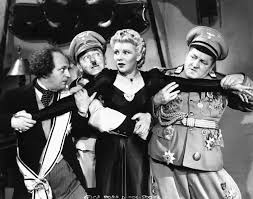
Tidbit Tuesday: The Three Stooges vs. Hitler


Ten months before Charlie Chaplin released The Great Dictator, the Three Stooges came out with You Nazty Spy. Produced by Columbia Pictures in January 1940, the film came out four months after Germany invaded Poland, and nearly a year before the U.S. entered the war.

Comprised of Larry Fine, and brothers Moe and Curly Howard, the Three Stooges began as the vaudeville act “Ted Healy and His Stooges” in 1922. Larry and Moe were the original stooges with the third played by various individuals throughout their fifty-year career. In 1934, the trio signed a contract with Columbia and became wildly popular within their first year. Their movies were typically “shorts,” films less than thirty minutes.

After WWII began, the Stooges (all of whom had Jewish heritage) put out several pieces that poked fun at Hitler and the Nazis, the first being You Nazty Spy with a sequel I’ll Never Heil Again the following year. Moe played “Moe Hailstone,” an Adolf Hitler-like character from Moronica, with Larry playing a Joachim von-Ribbentrop-type ambassador and Curly playing a Hermann Göring character. Consider by most to be the actors’ best film, You Natzy Spy is also the Stooges’ favorite.

In the movie, the evil cabinet ministers overthrow the king and decide to put Moe the new ruler, believing that he’ll be stupid enough to follow their orders. After successfully committing mayhem, the trio is run out of office by a mob and eaten by lions. A bit of a dark ending, but audiences loved it.

You Nazty Spy opens with a disclaimer that reads: “Any resemblance between the characters in this picture and any persons, living or dead, is a miracle.” Was this a Stooge-style eye poke at the censors or an attempt to appease them?

Other wartime movies by the Stooges included They Stooge to Conga, Higher Than a Kite, Back from the Front, Gents without Cents, and No Dough Boys. An anti-Japanese film The Yoke’s On Me was issued in 1944.  

Have you seen any of the Stooges’ wartime films?

___________________
___________________________
Linda Shenton Matchett writes about ordinary people who did extraordinary things in days gone by. Her latest release, Under Ground, features WWII war correspondent, Ruth Brown. A volunteer docent and archivist for the Wright Museum of WWII, Linda is also a trustee for her local public library. She was born a stone’s throw from Fort McHenry and has lived in historic places all her life. Now located in central New Hampshire, Linda’s favorite activities include exploring historic sites and immersing herself in the imaginary worlds created by other authors. Visit her website where she blogs about history, mystery, and faith. Sign up for her newsletter and receive a free short story. You can also connect with Linda on FacebookTwitter, and Pinterest.


Tuesday, December 10, 2019

Those Amazing Women and Their Flying Machines


Seventy-five years ago this month, the Women’s Air Service Pilots organization was disbanded. A federal organization, the WASPs was formed seventeen months earlier by merging the Women’s Flying Training Detachment and the Auxiliary Ferrying Squadron, both created in September 1942. 

As civilians, members of the WASPs were not in the military, however, in June 1944 the House considered HR 4219, a bill that would grant them military status. It was defeated 188 to 169. Two weeks prior, the House Committee on the Civil Service (Ramspeck Committee) reported that it deemed the WASPs “unnecessary” and “unjustifiably expensive,” having cost the government $50 million. They recommended the program be halted. 

During its period of operation, each member’s service had freed a male pilot for combat or other duties. The women flew over sixty million miles, transported every type of military aircraft, towed targets for live anti-aircraft gun practice, simulated strafing missions, and transported cargo.

More than 25,000 women applied to the WASPs. Qualifications were that the applicant must be between 21 and 35 years old, at least 5’2” tall, in good health, hold a pilot’s license, and have a minimum of 500 hours of flight time. Over 1,800 were accepted, the majority of whom were Caucasian. There were two Chinese-Americans, two Mexican-Americans, and one Native American.

Of those accepted, 1,074 completed the training. Although they were not trained for combat, their course of instruction was almost the same as male aviation cadets. The women received no gunnery training and very little formation and aerobatic flying, but they did go through the maneuvers necessary to be able to recover from any position. By graduation, WASPs had 560 hours of ground school and 210 hours of flight training. In addition, they knew Morse code, meteorology, military law, physics, aircraft mechanics, and navigation. 

On December 7, 1944 (Pearl Harbor Day), the last class of WASP pilots graduated from training, despite the plan to disband the organization. After the announcement was made, nearly two dozen women offered to continue the work at a salary of $1.00 per year, but the offer was rejected. Following the group’s disbandment, some WASP members were allowed to fly on board government aircraft as long as room was available and no additional expenses were incurred. The other had to arrange and pay for their own transportation home.

Several times during the 1970s efforts were made to gain recognition for the WASPs, but it was not until 1977 that President Jimmy Carter signed legislation P.L. 95-202 providing that service as a WASP would be considered active duty for the purposes of programs administered by the Veterans Administration. In 1984, each WASP was awarded the WWII Victory Medal, and those who served more than one year received the American Theater Ribbon/American Campaign Medical.

Would you ever consider learning to fly?

___________________________


Linda Shenton Matchett is an author, speaker, and history geek. A native of Baltimore, Maryland, she was born a stone's throw from Fort McHenry and has lived in historic places all her life. Linda is a member of ACFW, RWA, and Sisters in Crime. She is a volunteer docent and archivist at the Wright Museum of WWII. Find out more about Linda and her books on her website. Receive a free short story when you sign up for her newsletter. 


Tuesday, November 12, 2019

FDR and His Unprecedented Fourth Term


On November 7, 1944, Franklin D. Roosevelt became the first and only President of the United States to be elected for a fourth term. (Seven years later, the 22ndAmendment to the Constitution would limit the number of times a person could be president to two.) And if FDR’d had his way, Harry S. Truman would not have become the 33rdPresident.

Unlike in 1940 when the Democrats were split about who to nominate, Roosevelt easily won the nomination at the 1944 Democratic convention, making him the first person to serve as a major party nominee in four separate presidential elections. After successful leading the country through the Depression and three years of war, FDR was popular and faced little opposition within his party. Even though the Southern Democrats were unhappy with his racial policies, they were pleased with the amount of war activities and industries to their states, so they agreed with his nomination. Reports indicate there were a few pro-segregationist delegates who tried to get Virginia Senator Harry F. Byrd nominated, but Byrd refused to run.

Henry A. Wallace had been FDR’s Vice President since 1941, but there was significant opposition to putting him forward in the 1944 election. Some felt he was too left-wing and personally eccentric to be next in line for the presidency. Others remembered that he’d performed so poorly as economic coordinator, that Roosevelt had removed him from the post. 

Instead, party leaders introduced Harry Truman as a possible candidate, and after extensive conversations, Roosevelt reluctantly agreed to accept him as his running mate. FDR knew very little about Truman other than that he was a moderate from Missouri, and he’d performed well as chair of a Senate wartime committee investigating fraud and inefficiency in the war program.

Because of Roosevelt’s popularity, the Republicans knew it would be a difficult election to win. Initial nominees under consideration were Wendell Wilkie (the party’s 1940 nominee), Senator Robert Taft of Ohio (son of former president William Taft), and New York Governor Thomas E. Dewey. General Douglas McArthur even made the short list, but realizing he had a war to finish, party leaders didn’t move forward with his nomination. Taft choose not to run and suggested Ohio Governor John W. Bricker. The final pair consisted of Dewey as the Republican Presidential Candidate and Bricker as Vice-president.

Roosevelt won by a landslide, taking thirty-six of the forty-eight states. His decision to make Truman his running mate proved consequential. Roosevelt died in April 1945, and Truman became president on April 12th.


Linda Shenton Matchett is an author, speaker, and history geek. A native of Baltimore, Maryland, she was born a stone's throw from Fort McHenry and has lived in historic places all her life. Linda is a member of ACFW, RWA, and Sisters in Crime. She is a volunteer docent and archivist at the Wright Museum of WWII. To learn more about Linda and her books, including her latest release, Love's Allegiance, visit her website. Receive a free short story when you sign up for her newsletter.

Saturday, September 21, 2019

An Interview with Irwin Terrell of Love’s Allegiance


The history of conscientious objectors in the United States reaches back to the Revolutionary War. At that time, exemptions varied by state. During the Civil War conscientious objection was not part of the draft law for the federal side, but individuals could provide a substitute or pay $300 to hire one. In the Confederacy there were few options: moving to northern states, hiding in the mountains, joining the army but refusing to use a weapon, or being imprisoned. World War I saw little improvement to the handing of COs. In fact, when imprisoned they were often subjected to short rations, solitary confinement, and physical abuse.

Fortunately, World War II provided a better solution. Registrants were sent a questionnaire that included a checkoff to indicate opposition to military service because of religious training or belief. Anyone who marked the box then received a more detailed form on which they had to explain the basis for their objection. The Civilian Public Service provided COs an alternative to military service, and from 1941 to 1947 nearly 12,000 draftees served in this manner.

Meet Irwin Terrell, the hero in Love’s Allegiance who is a member of one of the Peace Churches, and as such, a conscientious objector.

LM: How did your family and neighbors react to your decision to apply for conscientious objector status?

Terrell: My dad is very supportive of my decision. We discussed my choice at length, and even though he doesn’t fully understand my reasoning or agree with it, he said that each man is responsible for his own life. He was adamant that I pray about my decision, which of course, I did. I feel that God led me to make the choice, however I don’t believe He leads everyone in that direction. Unfortunately, my friends are not so understanding, and I've been shunned by those who are still here. Townspeople with family serving overseas are also angry at me. I am alternate avoided and scorned. I have also received veiled threats. 

LM: Tell us about where your assignment during the war.

Terrell: I was assigned through the Civilian Public Service to serve at a mental health hospital. In addition to chores around the property such as maintenance and landscaping, I am responsible for attending to the men. I work six days a week and help the patients with self-care as well as occupation and physical therapy. We are hoping to help as many as possible to become self-sufficient.

LM: What are some of the other opportunities for COs to serve, and why didn’t you volunteer for one of them?

Terrell: The U.S. Forest and U.S. Park Services offered positions to help with forest and park maintenance. Even though I’m used to working outside on the farm, I wanted to do something different. There are also a number of experiments being performed in medical schools around the U.S. on men in an effort of discover cures for diseases such as typhus, infectious hepatitis, and malaria because our troops are exposed to these terrible ailments.

LM: Do you feel that taking up arms is wrong across the board or just for you?

Terrell:  Like my dad, I feel that each man must make the decision that is right for him. Unfortunately, we live in a sinful world and sometimes war becomes the only answer to overcoming evil.

LM: What is your favorite part of your job?

Terrell: I’m responsible for the gardens at the hospital. I have a cadre of patients who I work with. Seeing the joy as well as the understanding on their faces as they learn how to plant, maintain, and harvest the crops is gratifying. It is a step toward independence for them.

LM: What are your plans for after the war?

Terrell: My work at the hospital has spurred an interest in continuing to work in the mental health field. I’m not sure where God will lead me, but I believe it will be to minister to others in some way.

LM: I understand there is some possible romance in your life too. What can you tell us about that?

Terrell: You’re talking about Rochelle. My father thinks I have waited too long to marry, so he…uh…decided to give me some help. He contacted a distant cousin of his and they agreed to have her come work for him so we could explore a possible marriage. You’ll have to read how things turn out!

About Love’s Allegiance:
With most U.S. boys fighting for Uncle Sam in far off countries, Rochelle Addams has given up hope for a wedding in her future. Then she receives an intriguing offer from a distant relative to consider a marriage of convenience.

Conscientious objector Irwin Terrell is looking forward to his assignment at Shady Hills Mental hospital to minister to the less fortunate in lieu of bearing arms. At the arrival of the potential bride his father has selected for him, Irwin’s well-ordered life is turned upside down. And after being left at the altar two years ago, he has no interest in risking romance again.

Despite his best efforts to remain aloof to Rochelle, Irwin is drawn to the enigmatic and beautiful young woman, but will time run out before his wounded heart can find room for her?

Inspired by the biblical love story of Rebekkah and Isaac, Love’s Allegiance explores the struggles and sacrifices of those whose beliefs were at odds with a world at war.

Purchase Link: https://amzn.to/2ZXb9JQ


About Linda Shenton Matchett: Linda is an author, speaker, and history geek. A native of Baltimore, Maryland, she was born a stone’s throw from Fort McHenry (of Star Spangled Banner fame) and has lived in historic places all her life. Linda is a member of ACFW, RWA, and Sisters in Crime. She is a volunteer docent and archivist at the Wright Museum of WWII. Find out more about Linda and her books at http://www.LindaShentonMatchett.com. Pick up a free book when you sign up for her newsletter.

Tuesday, September 10, 2019

The Great Atlantic Hurricane of 1944


Over the course of human history, war has often been affected by the weather, and WWII did not escaped unscathed. The winter of 1941-42 had a major impact on troops after Germany invaded Russia. The invasion of Normandy was delayed because the forecast indicated poor weather which could have created overwhelming swells. Sweltering heat and humidity provided abysmal conditions for troops fighting in the tropics. The list could go on.

But perhaps no weather is as dangerous as a hurricane, and one was developing two hundred and fifty miles north of Puerto Rico in September 1944.

The military needed to know just how bad the conditions were going to be, so on September 9th, they sent an Army Air Force plane into the path of what would later become known as the Great Atlantic Hurricane. The craft encountered tremendous turbulence, and the weather officer onboard estimated wind speeds of 140 mph. Several times during the flight, the pilot and co-pilot lost control of the airplane, but fortunately, they landed safely. Later it was discovered that over 150 rivets had been sheared from just one of the wings.

Because of the foreknowledge about the storm, the government was able to provide warnings to the general public, so there was very little loss of life on land. The same could not be said for the sea. 

In Massachusetts, the lightship Vineyard was berthed in the entrance of Buzzards Bay and Vineyard Sound. The warrant officer in charge of monitoring the weather did not like what he saw and requested permission to move the ship to a more sheltered location. His request was denied, and the craft was later found sunk in eighty feet of water over a mile and a half from its original location. All hands were lost.

Over the course of seven days, the storm wreaked havoc on military shipping and sunk four ships: the destroyer USS Warrington, two Coast Guard cutters, and a mind sweeper. A total of nearly 400 sailors died.

Because of its ferocity, the hurricane drew many comparisons to the “Long Island Express” that ran roughshod over the mid-Atlantic just six years earlier. Crop and structure loss were extensive, and damage is estimated at $100 million. 


Today’s technology can detect infinitesimal changes in weather, and make predictions, but weather still has a mind of its own, and nothing is guaranteed.

I remember the Blizzard of 1978. What is the worse weather you’ve experienced?


Linda Shenton Matchett is an author, speaker, and history geek. A native of Baltimore, Maryland, she was born a stone's throw from Fort McHenry and has lived in historic places all her life. Linda is a member of ACFW, RWA, and Sisters in Crime. She is a volunteer docent and archivist for the Wright Museum of WWII. To find out more about Linda and her books, including her latest, Love's Allegiance, visit her website. Receive a free short story when you sign up for her newsletter.

Tuesday, August 13, 2019

The Liberation of Paris: 75th Anniversary


In order to write my recent Wartime Bridesseries, I’ve been doing a lot of research about the home front in countries other than the U.S. The information I’ve unearthed is fascinating. In many ways, life in the other Allied as well as the Axis nations was much like here – men called to arms, and women, children, and the elderly doing their part to work, volunteer, and support the war effort financially and through the collection of various types of scrap. 

However, the vast difference between these countries and the U.S. is that the conflict came to their front doors. America suffered very little war on our home soil. Yes, we were attacked at Pearl Harbor, and the territory of Alaska saw combat, but citizens on the “mainland” were isolated from belligerents marching through our cities and town. Countries occupied by Germany, Japan, and Russia suffered more than anyone. Heavy-handed mandates and violence punctuated their days and nights.

When freedom finally came, such as with the liberation of Paris seventy-five years ago, the inhabitants of the City of Lights were beside themselves with joy. Having lived under the jackboots of the Germans for more than four years, the French celebrated with abandon. As the Allied troops (predominantly American) traveled the roads north out of Normandy toward the capital, people cried, waved handkerchiefs, climbed onto jeeps, and hugged and kissed the soldiers. Civilians clogged the route so thickly, they slowed the convoy to the point where leadership was concerned about arriving late. 

Because the Germans knew the liberation was coming, they fled the city. Fortunately for Parisians, Von Choltitz, the German military governor, disobeyed Hitler’s order to destroy the city before leaving. He signed the official surrender on August 25, before being taken into custody. He was held prisoner until April 1947. 

Check out this U.S. produced news reel about the liberation.

How would you have reacted as a citizen in an occupied country?


Linda Shenton Matchett is an author, speaker, and history geek. A native of Baltimore, Maryland, she was born a stone's throw from Fort McHenry and has lived in historic places all her life. Linda is a member of ACFW, RWA, and Sisters in Crime. She is a volunteer docent and archivist at the Wright Museum of WWII. Find out more about Linda and her books, including Love's Rescue, (Wartime Brides series) set during the days leading up to the liberation of Paris: http://www.LindaShentonMatchett.com. Receive a free short story when you sign up for her newsletter.

Tuesday, July 9, 2019

Bretton Woods Trades Skis for Delegates


An area located within the town of Carroll, New Hampshire, Bretton Woods is primarily known for its nearly five hundred acres of skiing and snowboarding trails. Almost surrounded completely by the White Mountains, it features only two artificial structures: the Mount Washington Hotel and the Cog Railway.

Seventy-five years ago, this tiny hamlet was known for hosting over seven hundred delegates from forty-four countries during the “United Nations Monetary and Financial Conference,” also known as the Bretton Woods Conference.

Held from July 1-22, the conference was the culmination of nearly two years of conversations, committee meetings, and planning. Early in the war, John Maynard Keynes of the British Treasury and Harry Dexter White of the U.S. Treasury Department independently began to develop ideas about how to create worldwide financial order once the conflict was over. After negotiations between the U.S. and Britain, a statement was issued to many of the Allied countries inviting them to the conference “for the purpose of formulating definite proposals for an International Monetary Fund and possibly a bank for reconstruction and development.”

The invitation was met with enthusiasm, and experts flocked to the forests of New Hampshire to meet. By the end of the conference, representatives had penned Articles of Agreement for the IMF and the International Bank for Reconstruction and Development (IBRD), later known as the World Bank. In addition, the “Final Act” set up adjustable pegged foreign exchange market based on gold, and countries pledged to make their currencies convertible for trade-related and other transactions.

The monetary system, referred to as the Bretton Woods System by those in the financial industry, lasted until the early 1970s. The dollar exchange crises of 1971 and 1973 caused experts to create the floating exchange rate system that is still in place today.

After the agreements were signed, Fred Vinson, Secretary of the Treasury said, “History is being written today as we execute these documents and breathe the breath of life into the International Monetary Fund and the International Bank for Reconstruction and Development. We can be thankful that the history we are now writing is not another chapter in the almost endless chronicle of war and strife. Ours is a mission of peace – not just lip service to the ideals of peace – but action, concrete action, designed to establish the economic foundations of peace on the bed rock of genuine international cooperation.”

The representatives returned to their countries, and the valley returned to its idyllic silence.

Where have you traveled and used the exchange rate system?

Linda Shenton Matchett is an author, speaker, and history geek. A native of Baltimore, she was born a stone’s throw from Fort McHenry and has lived in historic places all her life. She is a member of ACFW, RWA, and Sisters in Crime. Linda is a volunteer docent and archivist for the Wright Museum of WWII. She and her husband make their home in Central New Hampshire, two hours south of historic Bretton Woods. To find out more about Linda and her books, including her latest, Love’s Belief, visit her website.  To sign up for her newsletter and receive a free short story click here.


Tuesday, June 11, 2019

Tuesday Tidbit: Enigma Decoded


In the last few years, much has been made about code breaking during WWII. Movies and books have come out about Bletchley Park and the men and women who worked there-tirelessly, under cover of secrecy, for years. Stories have recently come to light about husbands and wives, who unknown to each other, both worked at Bletchley and other similar facilities. Because of laws prohibiting workers from speaking about their assignments, it is only since the declassification of projects and information about the war that these people discovered they commuted to the same location day after day.

Code breaking took many forms during the war, because of the myriad ways codes were encrypted, but one of the most important projects was decoding Enigma.

Invented near the end of WWI by a German engineer named Arthur Schlerbius, Enigma looks somewhat like a typewriter. Approximately the same size, the machine features a series of rotors (also called wheels or drums) which turn by way of electrical contacts on either side. The wiring creates a substitution of letters and replaces them in some complex fashion. After encrypting each letter, the rotors advance which changes the substitution.

Enigma is family of machines that includes multiple designs. Therefore, in one sense work to decode the machine had to start over with each new edition.

In May, 1941 the Allies struck gold when the German weather ship München was attacked and found with Enigma code books for the following month on board. Then in June the supply ship Gedania and weather ship Lauenburg were also captured. Both had codebooks for July in their possession. Scholars and employees at Bletchley concur that the intelligence gained by these events was a significant asset and shortened the war.

Fast forward three years when the Americans captured the German submarine U-505 possessing an Enigma codebook on June 4, 1944. Authorities should have been ecstatic, right? Well, it turns out the timing for this was poor because of the date’s proximity to the landings at Normandy. The Navy classified the incident secret, towed the submarine to Bermuda where her crew was interned at a U.S. prisoner-of-war camp and denied access to International Red Cross visits. In addition, the U.S. sailors who took part in the capture were forbidden to discuss it under penalty of death.

Two captures. Two different outcomes.

Linda Shenton Matchett is an author, speaker, and history geek. A native of Baltimore, Maryland, she was born a stone’s throw from Fort McHenry and has lived in historic places all her life. Linda is a member of ACFW, RWA, and Sisters in Crime. She is a volunteer docent and archivist for the Wright Museum of World War II. 

Visit her website to learn more about Linda and her books, including her latest release Love’s Belief: http://www.lindashentonmatchett.com/p/books.html. Receive a free short story when you sign up for her newsletter.

Tuesday, May 14, 2019

Tuesday Tidbit: The Rosenstrasse Protest


“What if” is the crux of just about every story line created by an author. Historians sometimes explore the same question. What if the outcome of The Battle of the Bulge had been different? What if Julius Caesar hadn’t been assassinated? What if Thomas Dewey did or didn’t get elected? You get the picture.

The Rosenstrasse (Rose Street) incident, included in my latest release, Love’s Belief, occurred in Berlin, Germany during February and March 1943, and is one such moment in history that scholars ruminate over the outcome.

In 1935, the Nuremburg Laws were put into place in an effort to “protect German Blood and German Honour.” One of the associated mandates forbid marriage between Jewish and non-Jewish citizens, however, a later law protected those already married. As Hitler’s reign continued, more and more Jews were arrested, deported, and transported to labor and death camps. In Berlin, several hundred Jewish men married to Gentile women remained.

Eager to handle the “Jewish Question” and rid Germany, especially Berlin, of Jews, the Gestapo decided to circumvent the protection order and began to arrest Jews on various charges, including “impudence.” Most of those charged were men, and they were taken to a facility on Rosenstrasse where they were processed and held. Their wives immediately sprang into action and congregated outside the building where they indicated they would stay until their husbands were released.

Days went by with the soldiers sometimes threatening to shoot the protesters. News of the incident filter outside of Germany, and reports began to show up in newspapers around the globe. Realizing that he could neither shoot the women in cold blood which might cause further protests around the country, Goebbels released the prisoners during the first week in March, 1943.

German scholar Konrad Kwiet said of the protest, “the successful outcome of this late protest suggests that if similar actions at an earlier stage had been carried out throughout Germany, they might have halted the increasingly destructive course of the German anti-Jewish policy.” Do you agree with him?

___________________________________

About Loves’ Belief:
Midwife Pia Hertz and her mother Sabine have been delivering babies long before the Nazis came to power. Now, the Third Reich has implemented mandates that require Jewish babies and other “undesirables” to be killed as part of The Final Solution. Is Pia’s new faith in Christ strong enough to defy the laws of man?

Despite the agony of the injury at the Battle of Drøbak Sound that took his arm, Dieter Fertig is relieved he’s no longer part of Hitler’s army. He returns to Berlin and discovers Jews are being deported by the thousands. When he realizes the Nuremburg Laws require his best friend’s baby girl to be killed, he must find a way to spirit the child out of Germany before the Nazis discover her existence. 

Inspired by the biblical story of Shiprah and Puah, the midwives who saved Jewish babies during Pharaoh’s reign, Love’s Belief shows how one person’s actions can change the world.

Purchase Link: https://amzn.to/2LNe2pI


Linda Shenton Matchett is an author, speaker and history geek. A native of Baltimore, Maryland, she was born a stone’s throw from Fort McHenry and has lived in historic places all her life. Linda is a member of ACFW, RWA, and Sisters in Crime. She is a volunteer docent and archivist for the Wright Museum of WWII. To find out more about Linda and her books, including her latest release, Love’s Belief, visit http://www.LindaShentonMatchett.com. Receive a free short story when you sign up for her newsletter.