Showing posts with label Titanic. Show all posts

Tuesday, July 18, 2017

The Nazi Version of Titanic


Josef Goebbels was a failed writer and Adolf Hitler was a failed artist, but they saw themselves as film connoisseurs. They saw as many films as possible, many of which were not permissible in Nazi Germany because of Goebbels’ censorship laws.
Goebbels noted that American action and dramatic films were far more successful than those his propaganda ministry produced. Films like Casablanca, a blockbuster that gave a negative image of the Nazis. He recognized that his propaganda efforts were too heavy handed and obvious in their message.
After much study of American films, he decided he would create a Hollywood on the Rhine. And since the American film industry was populated by many successful Jewish directors, actors, producers, and scriptwriters, his films would be superior.
German screenwriter Harald Bratt wanted to create a movie based on Josef Pelz von Felinau’s 1936 book, Titanic: Tragedy of an Ocean Liner. Goebbels heartily approved. Their film would embarrass and demoralize the British, tarnishing their reputation and isolating them from the international community.
Goebbels’ epic film featured stunning special effects, lavishly done by director Herbert Selpin. The best actors and crew in Germany were recruited. The cast portrayed greedy, corrupt British capitalists, self-serving officers, cowardly first class passengers, and ethnic stereotypes.
Curiously, a lone German named Petersen was a member of the all-English ship’s crew. He alone continually cautioned against speeding through the ice fields of the North Atlantic. White Star Line head Bruce Ismay was portrayed as offering the captain thousands of dollars for every hour he arrived in New York ahead of schedule. His investors toasted him as a genius and rushed to telegraph their orders to buy up all the shares they could get.
As the ship sank, Petersen heroically rescued passengers, including Ismay, so he could be prosecuted for his crimes.
Despite a war going on, scenes were shot on location on the Baltic coast. The German liner Cap Arcona, in use as a floating barracks, had been inspired by the Titanic and built in 1927. It was quickly refurbished to portray its mentor.  Even though the war was turning against Germany, sailors were pulled off duty to serve as extras in the filming.

A passenger ship of the “Hamburg-South America” line,  
Cap Arcona sailed regularly between
Hamburg and Rio de Janeiro for twelve years.
The filming ran behind schedule and way over budget. Goebbels finally screened his masterpiece on December 17, 1942. He judged it a catastrophe. While intended to portray Britain as a nation of idiots, it closely mirrored Germany as the sinking ship under the command of a fool. And the graphic sinking scenes might offend families of German sailors lost in the war.
Goebbels banned his pet project. Despite all the pre-release hype, it was not shown in Germany. Eventually, it was shown outside of Germany in occupied territory and neutral nations. Audiences deemed it well-made.
And in 1958, a British film company producing Walter Lord’s A Night to Remember used the German footage of the climatic sinking scenes because of the quality and realism. At least it was good for something!

Tuesday, September 22, 2015

Ten Untrue Things You May Have Believed About the Titanic

Some of you know that I'm seeking publication for my novel based on a true story of a Titanic survivor. In the meantime, my blog features a different aspect about the ship each week. Here's a list of ten common misconceptions about the "unsinkable" ship.

1. Sixteen lifeboats plus four collapsible boats were all that were in the original plans.

False. The original plans called for 64 lifeboats. The owners and builders reduced it to 32, then to 16 because that was the number required by law at the time, and in order to make room for more deck space. The four collapsible boats were then added, bringing the number to 20.

TITAN9IKO8
Passengers strolling on the deck near lifeboats
 
2. Each of the four funnels had a purpose.

False. The fourth funnel was a fake, added to make the ship look grander.

titanic
Titanic leaving Southampton
 
3. On launch day, the ship was christened Titanic and a bottle of champagne was broken over her bow.

False. The White Star Line did not have naming ceremonies for any of their ships.

4. All passengers were bound for New York.

False. Fifteen first class passengers and nine second class passengers disembarked at the first port call, Cherbourg, France. A canary made the short trip as well, costing its owner 25 cents for the voyage across the English Channel from Southampton. At the second port call in Queenstown, Ireland, seven passengers disembarked.

01e18e1a1015e32a3675e218dbb66107
One of two tenders used to transport passengers to and from Titanic at Cherbourg
 
5. There was a grand ballroom for first class passengers.

False. There was no organized dancing onboard, although many steerage passengers danced to the lively music in the third class general room provided by passengers who had brought their instruments along.

th0ZI6QXMY
Part of the third class general room
 
6. Only the RMS Carpathia responded to Titanic’s distress call after the collision with the iceberg.

False. Three ships responded—the Olympic, the Frankfurt, and the Carpathia. The Carpathia was the closest at 58 miles away. Captain Smith of the Titanic knew it would not reach Titanic in time before she sank.

thS6QTQOWF
RMS Carpathia
 
7. Third class passengers could not reach the Boat Deck because they were locked behind gates.

False. Some of the gates were not locked. A few that were locked were opened by stewards after the collision. They helped guide women and children to the upper decks, but some of the women refused to leave the men. For others, language barriers and the maze of passageways below decks made it very difficult for steerage passengers to find their way. By the time they reached the Boat Deck, most lifeboats had already gone.

8. The Titanic sank intact.

False. The ship broke in half just prior to sinking. Many eyewitnesses had stated this, and it was proven when the wreck was finally explored.

thMPS1WUP8
Artist rendering of Titanic breaking in half prior to sinking
 
9. The iceberg made a long gash in the ship’s hull.

False. The iceberg scraped and bumped the riveted plates, causing the rivets to pop open and water to rush in. Again, this was discovered during the wreck exploration.

10. Due in part to the Titanic tragedy, cruise ships today are required to have enough lifeboats for all passengers on board.

Partly false. Modern ships are required by law to carry enough lifeboats for every passenger and crew member on board, plus 25%.

Please visit my blog at http://peggywirgau.com/ for more about the Titanic!
 

Friday, January 2, 2015

YOU Write the Story! Interactive Survival Adventures

 YOU Write the Story! Interactive Survival Adventures

Blogger: Amber Schamel

Have you ever wished you could make the choices for the characters in the stories you read? If you're like me, you've found yourself yelling "No! Don't do that. That's a really dumb idea." at a printed page or movie screen. What if there was a book that would allow you to make the choices and determine the outcome of the story?

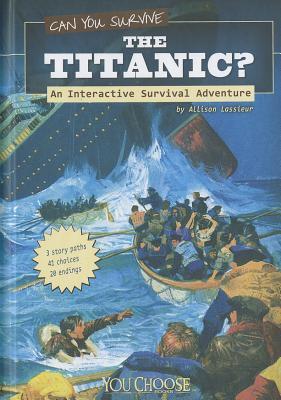
Over the holidays, a friend of mine introduced me to a series of books that does just that. It's the You Choose series from Capstone Press. This series is actually meant for young adults, but I've been enjoying the adventures as well. It's been a real hit with my young siblings and cousins. We've spent hours over the Christmas weekend living the adventures in this series. The series includes adventures in the Revolution, Civil War, Wild West, World Wars, Salem Witch Trials, and many more.

Here's how this works. My favorite so far is Can You Survive the Titanic by Allison Lassieur. In this adventure, you choose to experience the Titanic as a surgeon's assistant, a governess to a first-class family, or as a 12 year old boy traveling in third class to New York with his father. As your story begins, you will be faced with choices, and the choices you make could mean life or death.
https://www.goodreads.com/book/show/11690187-can-you-survive-the-titanic

For example, if you are the governess, you've just finished your dinner and have heard that the ship may be in trouble. You have the choice to either go tell your employer and his family right away, or attempt to find out more before waking them. You make many other choices throughout the story, and each choice changes the plot, and even the outcome. You may save the lives of the three children you care for and become their only living connection, or you may die trying to make sure they made it out of the cabin and to the lifeboats.

This is a really fun way for children to learn about history. Not only that, but the series also helps to paint a vivid picture in the child's mind, showing them that EVERY choice you make is important. Some choices may seem small and unimportant, like choosing to go to the port side or starboard side of the Titanic, but even that small choice determines whether you and your loved ones live or die.

As a writer, these books are a lot of fun, and serve as story fodder.

So, what about you? Do you like to imagine different endings or outcomes to stories? Or do you prefer to have it all written out for you?


Don't forget to leave a comment for your chance to win Max Lucado's Miracle at the Higher Grounds Cafe!

Tuesday, September 30, 2014

Pets on the Titanic - with New Contributor Peggy Wirgau

When the RMS Titanic sank in the Atlantic in 1912, over 1500 lives were lost. In addition to the people who died, several animals also lost their lives.

Passengers had to pay roughly the price of a child’s ticket to bring their pet aboard. It’s believed the ship carried 12 dogs belonging to 1st and 2nd class passengers, and several roosters and hens, most likely owned by steerage passengers, planning their new lives on American farms. A few dogs stayed in their owners’ cabins and others stayed in kennels in the cargo areas, along with the chickens.

Crew Members with dogs aboard Titantic

One pet belonged to the crew: Jenny the cat, whose job was to keep rats and mice at bay. Jenny had given birth to a litter of kittens prior to the ship’s first voyage out of Southampton, England. She was seen carrying each kitten, one by one, off the ship and into the city. A crew member who witnessed it decided Jenny knew something and was protecting her family. He quit his post and left the ship before it sailed.

When the Titanic struck an iceberg on the night of April 14th and began sinking, a crew member went below and opened the kennels so the dogs would have a chance to save themselves. But only three survived: a Pekinese belonging to Henry Sleeper Harper of Harper Publishing, and two Pomeranians. They were all taken onto the lifeboats by their owners. A story surfaced not long after the sinking that First Officer William Murdock’s black Newfoundland, Rigel, was seen swimming toward the rescue ship Carpathia and was adopted by the crew. That story was never proven true. Murdock perished in the disaster.

A dog show had been planned for the day of the sinking, which would have featured all the dogs on board. Also lost that day were the chickens. The fate of Jenny the cat is unclear, but we hope she remained in Southampton with her kittens and did not return to the ship.

Friday, February 21, 2014

My Family's Connection to the Titanic

It’s been over 100 years since the Titanic met its watery grave. Interestingly enough, my family has a connection to that famous, but ill-fated ship.

In 1911, my great-grandfather Tom Cadreanu left Romania to come to Canada, seeking a better life. He decided to brave the journey on his own to explore opportunities, find shelter and land. Once he was established, he sent word to his young wife, Amelia, to come to Canada with their daughter, Flora.

Passage was arranged for the two young travelers aboard the Titanic.

Given their economic condition, it was very likely that Amelia would’ve traveled third-class. And as everyone knows (thanks to James Cameron), the passengers at this level were not offered life boats. The third-class passengers sank with the ship. And so would’ve my great-grandmother…had she boarded that Titanic as planned.
 
Crowd awaiting survivors.
 
The saving grace was Amelia’s mother. She cried and begged her daughter to stay a little longer in Romania since she’d never see her again. Once they said good-bye, it would be forever. Handwritten letters that would take months to reach its destination would be their only connection. Amelia relented and delayed her departure an entire month.

You can imagine when Tom heard the news of the Titanic’s demise, he was devastated. He went months not knowing whether his wife and daughter lived or perished. I can only imagine that warm, Canadian spring day when they were reunited once again.

Tom and Amelia lived in the Niagara region and had 15 more children with 12 surviving.

I shudder to think the rippling effect of that one decision of a teenage girl to remain in her home country for four additional weeks. If she hadn’t, I wouldn’t be sitting at my computer writing this story now.

It also makes me pause to think about the moments when I feel that situations are out of control, that maybe they’re not. Perhaps God is working things out for a greater purpose than I can see or even know in the moment. Maybe that wrong turn that caused a 10-minute detour protected me from an accident. Maybe that rejection letter from an editor was meant to push me to be the better writer I can be. Maybe not getting a particular job spared me from a bad work situation. It’s learning to walk each day in faith, knowing my life is in His loving hands.

As Nazi Holocaust survivor, Corrie Ten Boom, once said, “Never be afraid to trust your unknown future, to a known God.”