Showing posts with label Deb Garland. Show all posts

Wednesday, July 13, 2016

English Soft-boiled Eggs - An Easy Recipe


My English husband’s favorite breakfast consists of two soft-boiled eggs with slices of buttered toast on a warm plate. Adding crispy slices of bacon or sausages round out this savory British breakfast. Egg cups and egg cozies to keep the cooked eggs warm come in a variety of themes and sizes to suit every décor and taste. We happen to own a pair of chicken egg cups given to us as a gift and a set of hand-knitted lamb egg cozies. Follow the instructions below to whip up this simple morning fare.


Instructions

1.     Select your favorite pair of egg cups, making sure the eggs fit in them.


2.     Pierce a tiny hole in each egg on its flat end. This prevents the egg from cracking while cooking.


3.     Gently place the eggs into a pot of boiling water and cook them for five minutes. This is a good time to make the toast and finish crisping the bacon or browning the sausage.


4.     Using tongs, place the soft-boiled eggs in the holders on a plate. Cover with your favorite egg cozies until it’s time to lop the top off the first egg’s shell with egg scissors.


5.     Season the soft-boiled eggs with salt and pepper to taste.


6.     Serve the soft-boiled eggs with toast, bacon or sausage, and fresh tomatoes alongside a cup of hot, steaming tea. Enjoy!


Have you eaten soft-boiled eggs for breakfast? What accompanied them? Do you own a set of egg cups or egg cozies? If so, what do yours look like? Don't forget to leave a comment to enter your name in the drawing for Dawn of Liberty by Amber Schamel! Winner announced in the Weekly Windup on July 18th. Check out all of our great prizes on the Prizes Galore page.

Cheers!

Deb


Deb Garland is an author, sailor & pastor's wife. She writes Christian historical romance novels steeped in Scripture & anchored in true stories of the Pacific Northwest, Canada, & Alaska. Winner of ACFW's First Impressions contest twice for historical romance, she lives on an island in Washington State with her husband of 35 years.


Wednesday, June 22, 2016

Kouign Amann - A French Pastry Recipe

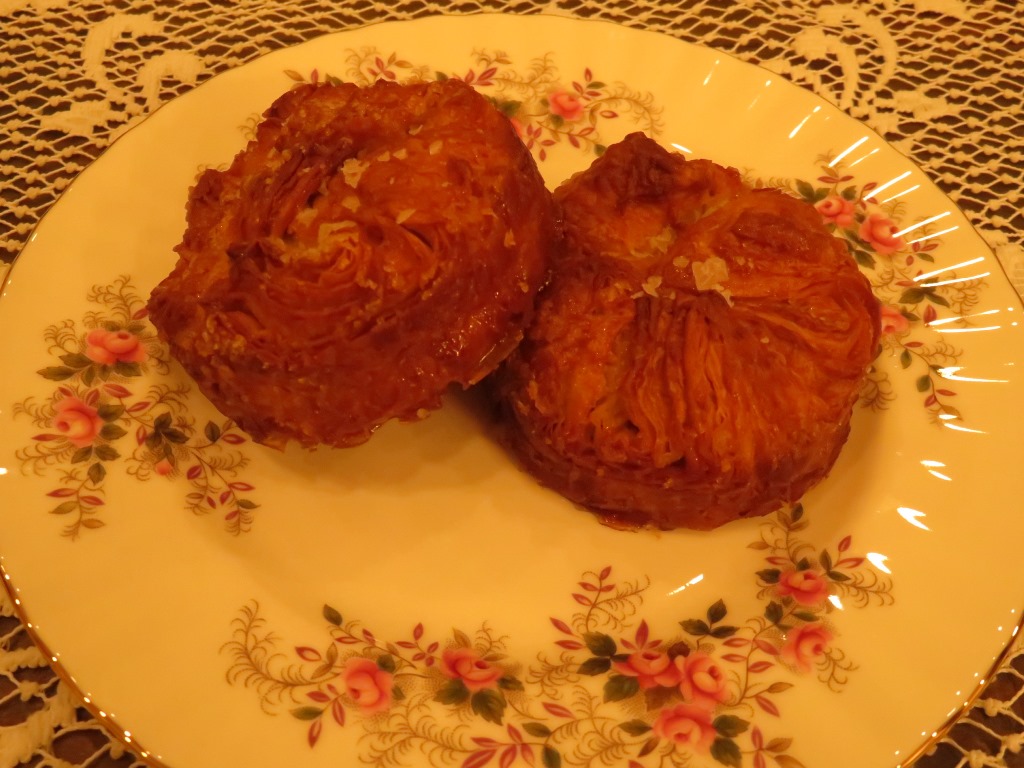
Pinch me! Am I in the middle of Paris? One taste of a delicious, buttery, flaky Kouign Amann at the Breadfarm Bakery in Bow Valley, Washington, convinced me I needed to find a recipe for this French pastry. The origin of this taste sensation started in the 1800s in Brittany, France. The Breton name means “cake-butter,” referring to the layers of butter and sugar folded into a yeast dough. Fresh fruit, chocolate, cinnamon, and coconut often fill many Kouign Amann pastries.
Kouign-Amann_9125-1024
Kouign Amann

1 cup warm water
2 teaspoons active dry yeast
1 cup plus 1 tablespoon sugar, divided use
¼ cup dark brown sugar (I like the flavor brown sugar imparts, for a milder caramelized flavor use all white sugar instead)
2 cups plus 2 tablespoons all-purpose flour, plus additional for dusting
1 teaspoon salt
6 ounces salted butter
In a large bowl (or in the bowl of a stand mixer) combine the warm water (it should be about 105°F) with the yeast and one tablespoon of sugar. Stir the mixture and allow it to sit for several minutes, until the yeast dissolves.
Add the flour and salt to the yeast. If using a stand mixer, knead the dough with the dough hook on medium-high speed for about 8 minutes, or until smooth and elastic. If kneading by hand, knead the dough for at least 10 minutes, or until smooth and elastic. If the dough is still tacky you can add a few extra tablespoons of flour while kneading.
Place the dough into a greased bowl. Cover the bowl lightly with plastic wrap or a kitchen towel and place it in a warm place for about 1 hour or until doubled in volume. Punch down the dough and allow it to rest for several hours or up to overnight. While the dough rests, remove the 6 ounces of butter from the fridge. Place the butter between two sheets of parchment paper and pound it into a rectangle, about ¼ inch thick. Place the butter back into the refrigerator so that it remains chilled.
On a lightly floured surface, roll the dough into a rectangle that is also about ¼ inch thick. The dough should be about 10 inches wide and 18 inches long. Place the chilled and pounded rectangle of butter into the center of the dough.
Fold the top half and bottom half of the dough evenly over the butter. Once folded, be sure that the folds in the dough are facing towards you. Give the dough its first roll using a rolling pin. Roll the dough out evenly. Be careful not to pinch the edges of the dough, or to press down so hard that the butter begins to squeeze out. Roll the dough until it is a rectangle, almost as large as the rectangle you started with. If the dough sticks at all, use a bit of flour to prevent sticking. Fold the top third of the dough down and the bottom third of the dough up, so that it again looks like a book, with the folds facing you.
Wrap the dough in parchment or plastic wrap and place it into the refrigerator for at least 30 minutes to chill. Repeat the above process two more times, each time rolling the dough out, folding the dough into thirds (so that there are three even layers of dough), make sure that the layers are facing you when you roll, and chill for at least 30 minutes between rolling and folding. You can leave the dough like this overnight if you wish, and do the final turn the next morning.
For the 4th and final turn, sprinkle a half cup of the granulated sugar on the work surface. Place the dough on top of the sugar and sprinkle one-fourth cup on top.
Roll the dough out. Fold the dough once more into thirds, top half down and bottom half up. Chill the dough for 20 minutes. Combine the brown sugar (if using) with the remaining white sugar, Sprinkle half on the work surface, place the dough on top and sprinkle the rest of the sugar evenly over the dough. Roll the dough out into a long rectangle, about 8 inches wide by 24 inches long. Cut the dough into two strips, and then cut the dough into 4”x4” squares.
Gather the squares up by the four sides. Place the center into a well-greased muffin tin, pulling the four corners towards the center of the muffin tin, so that it gathers up like a blossoming flower.
Repeat this process until all the muffin tins are filled with the dough. Place the Kouign Amann in a warm place to proof slightly. It should begin to puff slightly before you put it into the oven. While the Kouign Amann proofs, preheat the oven to 375°F, with a rack in the center position.
Bake the Kouign Amann for about 30 minutes, or until golden brown. Remove them from the oven and allow them to cool slightly. Only allow them to cool enough so that you don’t burn yourself on the caramelized sugar when trying to handle them. Remove immediately from the muffin tins. If you leave them in the muffin tins until they cool completely they will be impossible to get out. Serve them warm or at room temperature. Makes 12 individual cakes.

A few tips:

  • Use the highest quality of butter available.
  • Use salted butter to balance out the sweetness.
  • Work in a cool kitchen when rolling butter and layering it into dough. If it warms and begins to melt into the dough, you won’t get those nice, flaky layers. Try to avoid touching the dough too much and work quickly.
  • Do not layer your sugar into the Kouign Amann until the final turn. Sugar absorbs moisture, so if you layer the sugar into the dough too early, it tends to get very wet and tacky. This makes it harder to roll and fold the dough. The best result comes from adding it during the final turn.
*Recipe by Marisa Churchill (with slight modifications) 

Enjoy making a batch of Kouign Amann's and share them with family and friends. Do you have a favorite pastry you like to make or buy at a bakery? Is it plain or filled with something delicious? Don't forget to leave a comment to get your name in the drawing for the Lone Star Love collection! Winner will be announced in the Weekly Windup on June 27th. Check out all of our great prizes on the Prizes Galore page.
Cheers!
Deb
Deb Garland is an author, sailor & pastor's wife. She writes Christian historical romance novels steeped in Scripture & anchored in true stories of the Pacific Northwest, Canada, & Alaska. Winner of ACFW's First Impressions contest twice for historical romance, she lives on an island in Washington State with her husband of 35 years.

website: www.debgarland.com
facebook: http://www.facebook.com/deb.garland.39
twitter: http://twitter.com/debgarland1
pinterest: http://www.pinterest.com/deb30551/
linkedin: http://www.linkedin.com/in/debgarland

Wednesday, May 18, 2016

A Tea Trivia Quiz

One of my favorite restaurants to sip tea with family and friends is the Abbey Garden Tea Room in the Fairhaven area in Bellingham, Washington. Established in 1998, it is a contemporary, British-styled tea room with interior décor similar to The British Pantry in Seattle and the James Bay Tea Room in Victoria, British Columbia, Canada. Over 40 kinds of loose leaf teas are served alone or with savory and sweet menu items, so everyone may discover the tea they like best.

Abbey Garden Tea Room
Until I visited Murchie’s Tea & Coffee in Victoria, I had no idea so many varieties of tea existed. Nor did I know that all teas come from the same plant, only the processing is different. Black teas undergo the most fermentation and oxygenation, green teas endure the least, and white teas are made from unprocessed leaves. Additional flavoring is added to scented teas. Beside the familiar teas like English Breakfast sold by all tea makers, several companies blend their own teas for their customers. Click here to visit Murchie’s website and read descriptions of the teas they sell. My personal favorite is their No. 10 Blend, named after London’s famous No. 10 Downing Street.


Curious about tea? Take the Tea Trivia Quiz!
Answers follow the list of questions.

1.     Tea contains about _____ the amount of caffeine as coffee.
A.    twice         B. the same     C. one third     D. half

2.     The term “orange pekoe” refers to…
A.    Herbal teas flavored with citrus
B.    A premium black tea with unbroken leaves
C.    The color of the leaf on a tea bush
D.    A type of white tea

3.     “Women are like tea bags. They do not know how strong they are until they get into hot water.” Who said this?
A.  Marie Curie
B. Eleanor Roosevelt
C. Elizabeth II
D. Jackie Kennedy

4.     A tea bush takes three to five years to grow before it is ready for harvesting.
True or False

5.     Using a samovar is the traditional way to boil water for tea in which country?
A.    India          B. Russia         C. Germany    D. Spain

6.     Which country is the world’s largest producer of tea?
A.    Ireland       B. China          C. India           D. Brazil

7.     Assam tea is named after…
A.    the city where it found its popularity.
B.    the surname of its discoverer.
C.    the Hindi word for its malty flavor.
D.    the region it is grown in.

8.     Darjeeling is often referred to as the _____ of teas.
A.    Mother      B. Champagne            C. Chardonnay            D. King

9.     For every 400 tons of Darjeeling tea sold, only 100 tons are genuinely from the Darjeeling district of India.
True or False

10.  Which region is the world’s largest consumer of tea?
A.    Ireland       B. Japan          C. United States          D. England

11.  How many different varieties of tea does the world offer?
A.    Over 3,000  B. Around 500  C. Less than 100  D. Approximately 1,500

12.  In which city was the tea bag invented?
A.    Beijing      B. London       C. New York   D. Mumbai

13.  Which country was enjoying iced tea as early as the 1840s?
A.    Russia       B. South Africa           C. Wales         D. Japan

14.  Americans drink over fifty billion cups of tea per year.
True or False

ANSWERS: 1.D  2.B  3.B  4.T  5.B  6.C  7.D  8.B  9.T  10.A  11.D  12.C  13.A  14.T

Tony, my favorite Brit, sipping tea at the Abbey Garden Tea Room
A Bonus Question

15.  The best teas come from Asia. Match the teas with their nations of origin.
1.     China
2.     India
3.     Sri Lanka
4.     Japan
5.     Taiwan

Choose from:

A. Ceylon  B. Keemun  C. Darjeeling  D. Oolong  E. Assam   F. Gen Mai Cha  G. Sencha

ANSWERS: 1.B  2.C/E  3.A  4.F/G  5.D

I hope you enjoyed taking the Tea Trivia Quiz. Did any of the answers surprise you? Did you learn something new? If you'd like, share the name of your favorite tea and/or tea room! Leave a comment to be entered in our Stitches Thru Time Writers’ weekly giveaway, Dawn of Liberty, by Amber Schamel.

Cheers!

Deb

Deb Garland is an author, sailor & pastor's wife. She writes Christian historical romance novels steeped in Scripture & anchored in true stories of the Pacific Northwest, Canada, & Alaska. Winner of ACFW's First Impressions contest twice for historical romance, she lives on an island in Washington State with her husband of 35 years.


Wednesday, April 20, 2016

An English "Ruched" Teapot Cozy Knitting Pattern

Tea cozies can be knitted, sewn, and quilted in a large variety of designs to match one’s individual taste and kitchen décor. A teapot with an accompanying tea cozy is a fabulous gift for family members and friends on special occasions. These gifts are a fun way to introduce the “uninitiated” to a new taste sensation. I’ve often filled the teapot with assorted teabags, wrapped the teapot in a colorful knitted cozy, and attached a note card to the handle with instructions on how to brew the tea. Sometimes I’ve added a cookbook of teatime recipes.


Today, I’d like to share an advanced ruched tea cozy pattern my English mother-in-law taught me. At the time, I was an inexperienced knitter. I made the mistake of learning how to read the pattern and practice knitting on a single afternoon a few weeks before my husband and I left for an extended summer sailing vacation around Vancouver Island, BC, Canada. I took along the yarn, the pattern, and—found I’d forgotten what she taught me!


The ruched pattern

About this time, we befriended a Canadian couple on a ketch named Race Passage. I met Lily, a fabulous knitter from Denmark. She crafted fancy sweaters with appliqued flowers on them, selling over 30 of them annually to raise funds for handicapped children. One afternoon, while the men explored our anchorage, we sipped tea together and knitted in their cockpit. She retaught me the pattern. Here is a photo of the teapot I keep aboard our sailboat and the tea cozy my mother-in-law knitted for us. Normally, I keep the teapot on a hot pad on the galley counter or salon dining table, because the top of the diesel stove is very hot. We use the stove to cook and heat our boat when we are at sea. 


English Ruched Tea Cozy


Materials: 1 ½ oz. in gold and 1 oz. in white (or your choice of colors); 1 pair of #3 (US) or #10 (UK) knitting needles; a medium-sized crochet hook.
Measurement: Height, 7 ins.
Gauge: 5 sts. to 1 in.
Note: The wool is used double throughout. (I've used it single, but it's best double.)

Instructions


Using gold wool, cast on 53 sts. and work 3 rows in moss stitch.
Next row: p. Change to white.
Next row: k.
Next row. p.
Change to gold and work in pattern as follows:
1st row: k.
2nd row: p.
Rep. these 2 rows once more.
5th row: With white - * k. 3, drop the next st. down 4 rows, then k. the st. from the 5th row, together with the loops; rep. from * to the last st., k. 1.
6th row: With white, purl whole row. With gold, work 4 rows in stocking stitch.
11th row: With white -  k.1, * drop the next st. down 4 rows, then k. the st. from 5th row, together with the loops, k. 3; rep. from * to end.
12th row: With white, purl whole row.
These 12 rows form one pattern. Continue to rep. them until a 6th or 12th row. Break off white.
Next row: k. 2, * k. 2 tog., k. 1; rep. from * to end.
Next row: * p. 1, make 1, p. 2 tog.; rep. from * to end. Work 4 rows in moss stitch. Cast off.
Make another section in the same way. Press the moss stitch borders, then join the two sections together, leaving an opening at each side for spout and handle. With 4 strands of white wool crochet a 16-in. chain, thread this through holes, draw up and tie in a bow. Sew a tassel to each end of the chain.

Notes

  • I use washable wool.
  • Use the crochet hook to drop the stitch down 4 rows.
  • Moss Stitch: 1st row – Knit one, purl one. 2nd row – Purl one, knit one.
  • Stocking Stitch: Knit one row. Purl the next row.

I like to knit tea cozies, hats, scarves, and sweaters. What do you like to crochet or knit? Please leave a comment to enter our weekly Stitches Thru Time Writers giveaway.

Cheers!

Deb

Deb Garland is an author, sailor & pastor's wife. She writes Christian historical romance novels steeped in Scripture & anchored in true stories of the Pacific Northwest, Canada, & Alaska. Winner of ACFW's First Impressions contest twice for historical romance, she lives on an island in Washington State with her husband of 35 years.

Wednesday, March 23, 2016

Have a Crumpet and Tea

I’ll never forget one wedding anniversary. On a beautiful summer day, my husband and I set sail aboard the SS Princess Marguerite II, a 1948 Scottish-built steamship owned by the B.C. Steamship Company, taking tourists from Seattle, Washington to Victoria, BC, Canada. We didn’t partake of crumpets and tea while cruising at 23 knots on the 373-ft. ship, but we did enjoy exploring the elegant wood-paneled cabin and wide promenade decks.


And whenever we eat crumpets, we hear the B.C. Steamship’s advertising jingle with the Princess Marguerite II’s steam whistle blasting at the end in our heads!

Take a princess to sea
Have a crumpet and tea
Let's go to Victoria
With Princess Marguerite . . .

I may not be able to invite you aboard the Princess Marguerite II, but I can share a crumpet recipe with you from my Tea & Crumpets cookbook by Margaret M. Johnson.


Crumpets

1/2 cup water, heated to 110°F
2 teaspoons sugar
1 envelope active dry yeast
2 1/2 cups all-purpose flour
1 teaspoon salt
1/2 teaspoon baking soda
1 1/2 cups milk, warmed
Butter, at room temperature
Strawberry or raspberry jam for serving

In a large bowl, combine the water, sugar, and yeast. Let the mixture sit for about 5 minutes or until foamy. Stir in the flour, salt, baking soda, and milk. Cover and leave in a warm place for about 30 minutes, or until the mixture has risen.

Butter a large nonstick skillet and place it over low heat. Generously butter 2 1/2-inch crumpet rings or biscuit cutters. Place the rings in the skillet and fill each halfway with batter. Cook over low heat for 10 minutes, or until small holes appear and the top has started to dry. Remove the rings, turn the crumpets over, and cook for 1 to 2 minutes, or until lightly browned. Repeat with the remaining batter. Serve warm or toasted with butter and jam.

How many of you have made crumpets? How does your recipe or method of making them differ? Please leave a comment to be entered in our Stitches Thru Time Writers weekly giveaway.

Cheers!

Deb

Deb Garland is an author, sailor & pastor's wife. She writes Christian historical romance novels steeped in Scripture & anchored in true stories of the Pacific Northwest, Canada, & Alaska. Winner of ACFW's First Impressions contest twice for historical romance, she lives on an island in Washington State with her husband of 35 years.

website: www.debgarland.com
facebook: http://www.facebook.com/deb.garland.39
twitter: http://twitter.com/debgarland1
pinterest: http://www.pinterest.com/deb30551/
linkedin: http://www.linkedin.com/in/debgarland

Wednesday, February 17, 2016

A Teapot Cozy Knitting Pattern

Teapots and their cozies keep the tea inside warm. They come in all shapes and sizes, plain and decorated. Tea connoisseurs can choose from crocheted, knitted, quilted, and sewn tea cozies to suit their taste or those of their family and friends. Cozies make great gifts, especially for wedding showers in the bride-to-be’s colors. I’d like to share my version of one easy pattern from Paton’s Beehive Bazaar Novelties and Gifts (#115 booklet), but you can find many free patterns online.

Knitted Striped Tea Cozy

MATERIALS:

Use three colors of washable wool yarn to knit this six cup size tea cozy with stripes and petal trim. I made a pom-pom in lieu of the petals. You will need 1 (50 gram) ball each of Dark (D), Medium (M) and Light (L) yarn. Two U.S. 5 knitting needles.
With (D) cast on 48 sts. and knit 4 rows Garter st. (plain knitting every row). Join (L) and proceed for
STRIPE PATTERN:
1st row: With (L) knit.
2nd row: K1. *P2. K2. Repeat from * to last 3 sts. P2. K1.
3rd row: K3. *P2. K2. Repeat from * to last st. K1.
4th tow: As 2nd row
5th and 6th rows: With (D) knit.
7th row: With (M) knit.
8th row: As 3rd row.
9th row: As 2nd row.
10th row: As 3rd row.
11th and 12th rows: With (D) knit.

Repeat these 12 rows for Stripe Pattern until work measures 5 ½ ins. from beginning, ending with 6th or 12th pattern row. Break (L) and (M). With (D), proceed:
Next row: *K1. K2tog, K1. Repeat from * to end of row. (36 sts. on needle). Knit 5 rows Garter st.
Next row: *K1, K2tog. Repeat from * to end of row: (24 sts. on needle. Knit 5 rows.
Next row: (K2tog.) 12 times. Knit 3 rows.
Next row: (K2tog) 6 times. Break wool. Thread through remaining sts. Draw up and fasten securely. Darn in ends.

Make another piece to correspond. Sew side and top seams, having openings for handle and spout. With (D), crochet 1 row s.c. (single chain) around the handle and spout openings.

PETALS:
With (D) cast on 5 sts.
1st row: Knit.
2nd row: Inc. 1 st. in 1st. st. K3. Turn.
3rd row: Slip 1st st. knitways. Knit to end of row.
Repeat 2nd and 3rd rows twice.
8th and 9th rows: Knit.
10th row: K2tog. K5. Turn.
11th row: As 3rd row.
12th row: K2tog. K3. Turn.
13th row: As 3rd row.
14th row: K2tog. K1. Turn.
15th row: Sl 1. K1. Cast off

Make 1 more with (D), 2 with (L) and 2 with (M). Arrange the petals on top of cozy, alternating colors and sew in position at center. Crochet in s.c. (single chain) around ring and sew in center of petals.

Have you made a tea cozy? What kind did you make? I’d love to hear about yours! Any tips for our STT readers? Don't forget to leave a comment to get your name in the drawing for While I'm Waiting Devotional by Laura Hodges Poole! Winner announced in the Weekly Windup on the 29th. Check out all of our great prizes on the Prizes Galore page.

Cheers!


Deb

Wednesday, February 10, 2016

Palmiers for Valentine’s Day

Show God's love to your family and friends by sharing a French heart-shaped dessert with them on Valentine’s Day. Served with coffee, tea, or milk, everyone will enjoy this light, crisp pastry baked to sugary perfection. And it takes two ingredients—puff pastry and granulated sugar—and a wee bit of time.


I discovered Palmiers at a local bakery in Edison, WA, called the Breadfarm. But you can make them yourself. This recipe is from Taste of Home.


Palmiers

TOTAL TIME: Prep: 20 min. Bake: 20 min.
MAKES: 24 servings

INGREDIENTS:
1 cup sugar, divided
1 sheet frozen puff pastry, thawed

DIRECTIONS:

Sprinkle a surface with 1/4 cup sugar; unfold puff pastry sheet on surface. Sprinkle with 2 tablespoons sugar. Roll into a 14-in. x 10-in. rectangle. Sprinkle with 1/2 cup sugar to within 1/2 in. of edges. Lightly press into pastry.

With a knife, very lightly score a line widthwise across the middle of the pastry. Starting at one short side, roll up jelly-roll style, stopping at the score mark in the middle. Starting at the other side, roll up pastry jell-roll style to score mark. Cut into 3/8-in. slices.

Place cut side up 2 in. apart on parchment paper-lined baking sheets. Sprinkle lightly with 1 tablespoon sugar.

Bake at 425° for 12 minutes. Turn pastries over and sprinkle with remaining sugar. Bake 5 minutes longer or until golden brown and glazed. Remove to wire racks to cool completely. Store in airtight containers. Yield: About 2 dozen.

Some people like to substitute cinnamon sugar, but it's entirely your choice. Have you heard of Palmiers? Tasted them? Baked them yourself? By all means, share what you know about making French pastries and leave a comment to enter our Stitches Thru Time weekly giveaway. And go share a Palmier with someone special!

Cheers,

Deb


Wednesday, January 20, 2016

English Brown Betty Teapots

A cherished bit of English history resides in its traditional Brown Betty teapots. Stoke-on-Trent in Staffordshire, a city 160 miles northwest of London, became famous for making pottery in the Middle Ages. In fact, the village was nicknamed the Potteries due to the region’s abundance of a superior form of red clay that retains heat more than any other clay.
Tea drinking spread beyond the upper class to all families in British society in the early 19th century. This demand increased the production of china teapots and teacups by the Wedgewood, Spode, and Royal Doulton companies, rivaling their Chinese porcelain counterparts, and brought renown to the Staffordshire clay teapots.
I’m a tea drinker who believes the Brown Betty teapot makes one of the best pots of tea. Several cups of hot tea can be poured before it is necessary to replenish the teapot with fresh tea and hot water. The teapot’s round shape enables loose tea leaves to swirl in the boiling water, ensuring complete infusion. The dark manganese glaze, known as a Rockingham glaze, gives the Brown Betty its distinct color, hiding tea stains over time.
How are Brown Betty teapots made? Once they were thrown on a potter’s wheel with the hand and spout added afterward. Now they are poured into a mold using a slipcasting method. After the teapot is released from the mold, it is allowed to dry naturally. Then it is smoothed (fettled) and fired in the kiln for the first time. Next, the teapot (in biscuit form) is dipped into the Rockingham glaze and left to dry naturally again. Excess glaze is removed from the bottom (footswiping) and the lavender-colored pot is fired in the kiln a second time to create the glossy chocolate-syrupy color of the Brown Betty teapot.
If you would like to own a new Brown Betty teapot, two Stoke-on-Trent companies still make these treasured heirlooms, Cauldon Ceramics, Ltd. and Adderley Ceramics, Ltd.. Of course, you can find Sadler or Alcock, Lindley & Bloore Brown Betty teapots in antique stores and vintage shops. To determine if you own an authentic Brown Betty teapot, turn it upside down to see if you can see the unglazed red clay and the words “Made in England” on the bottom.Other countries have copied the Brown Betty style teapot and I own an Old Amsterdam Porcelain Works teal green teapot that is a close cousin to my favorite Sadler teapots in various sizes.

            Do you own a teapot? Enjoy sipping tea? Or have you visited England, the land of tea? Please share and leave a comment to place your name in the drawing for Amanda's Beau by Shirley Raye Redmond! The winner is announced in the Weekly Windup on Feb. 1. Check out all of our great gifts on the Prizes Galore page.

Cheers!
Deb